
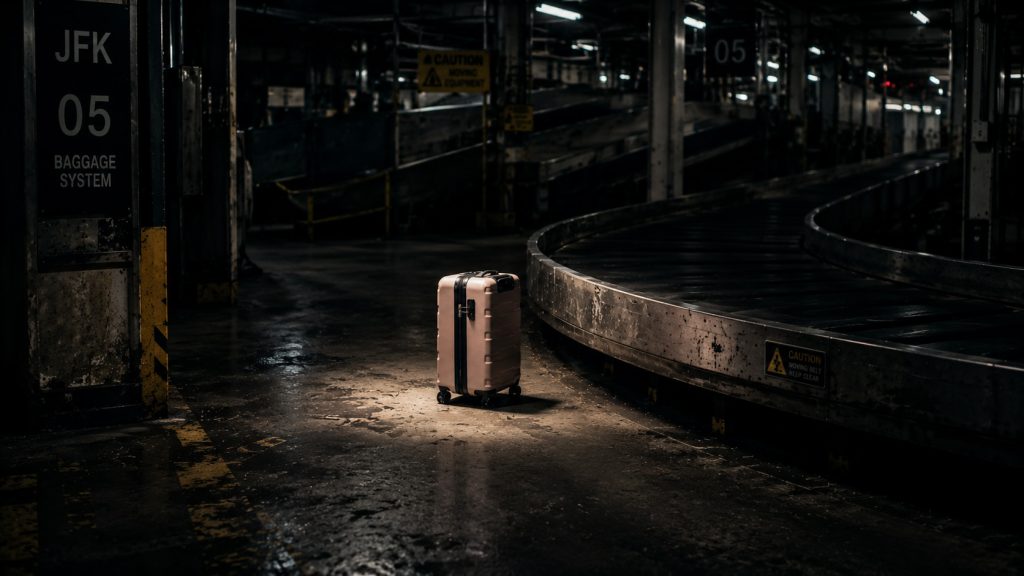
The trip started with a missing suitcase.
I landed at JFK, excited to see my son and daughter-in-law at their new home in Kingston, NY. I landed, but my suitcase did not. It was on the next flight, I was told, which would land in another 3 hours. Sounded promising, but I did not want to lose a minute of my precious time with my son. I was assured it would be brought to me before the end of the day. I seriously doubted the assertion. Surely. I would receive the bag by the next morning. Inside that bag, packed with care, was cheese my family had requested from home.
Three days later, when the suitcase finally arrived, I did not need to open it to know what had happened. The smell announced itself. What began as a gift had become something else entirely, transformed by time and circumstances beyond my control.
I did not know it yet, but that suitcase was the opening act of a week-long lesson in everything we cannot control.
Driving Through Smoke
Wildfires raged in Canada, and their smoke drifted south with no regard for borders or plans. I drove from Kingston, New York, to Weston, Connecticut, then on to Cape Cod, and finally to New York City. The sky turned the color of weak tea. I did not dare open the window.
I was hundreds of miles from any flame, yet the fire found me anyway. It filled my lungs. It changed my plans. It reminded me, hour after hour, that distance from a disaster is no guarantee of immunity from it. Fortunately I had my N95 masks with me.
The smoke in Canada however caused an important meeting (at least to me) to be postponed since the people I planned to meet with were in Canada, waiting for the smoke to clear, so they could complete a photo shoot.
Time to go back home. But then came the storm. It grounded nearly every flight out of JFK, including mine. I sat for five hours, watching the departure board, watching other travelers pace and bargain and give up, until the cancellation finally came. Every hotel in the area was booked, filled by stranded passengers and fans in town for the World Cup Final. I paid $522 for one night at a Super 8 in Queens and considered myself lucky to get it.
We were all just trying to get home. None of us could.
The Poem That Found Me
That same week, I read Maura McInerney-Rowley’s essay in the Hello Mortal newsletter about Joan Kwon Glass’s poem “Wildfire,” written in homage to Anne Sexton. The timing felt less like coincidence and more like an appointment I had not known I was keeping.
In the poem, wildfire smoke settles over a coastal city on the anniversary of a devastating loss. A ten-year-old daughter asks whether the person who died left a note. The smoke drifts. The grief stays.
What struck me most is that the wildfire is not simply a metaphor for grief. It reveals grief’s nature. Like smoke, grief travels beyond its point of origin. It reaches people who were never present at the death. It crosses generations. It settles into places we never expected. We cannot control where it goes or when it resurfaces. A child inherits a loss she had no part in. A community breathes air from a fire it never saw. The boundaries we draw on maps mean nothing to smoke, and they mean nothing to sorrow.
Who Am I Without It?
One line from the poem stayed with me above all others: “What will fill my lungs?”
On the surface, the narrator is noticing that her anger has begun to fade, and instead of relief, she feels a new loss. I hear something deeper in that question. If grief changes, who am I without it?
In my years of work in the grief space, I have met so many people who fear that healing means leaving their loved one behind. That if the anger softens, if the weight lifts even slightly, they have somehow betrayed the person they lost. But grief does not work that way. Our relationship with grief continues to evolve, just as our relationships with the living do. The love does not diminish when the anger fades. It simply learns to breathe differently.
Grief Is Communal
That week of smoke and storms reminded me how interconnected we all are. Even those far from the flames experience their effects. Grief works much the same way. We carry not only our own losses but are affected by the suffering of others, whether through family, community, or events unfolding across the world.
My work with Grief Dialogues has continually shown me that grief is never isolated. It is communal. When we gather in a theater to witness stories of loss, we are acknowledging what the smoke already knows: that we breathe the same air, that what happens to one of us reaches all of us, that no one grieves alone even when they feel most alone.
We cannot prevent every fire or every loss. The suitcase will go missing. The flight will be cancelled. The smoke will come. But we can choose how we respond: with compassion, with conversation, and with presence for one another.
An Invitation
I am grateful to Maura McInerney-Rowley for introducing me to Joan Kwon Glass’s poem. It captures, with remarkable economy, how grief can both confine us and connect us, often at the same time.
I invite you to read the poem and the essay, and then to ask yourself the question the narrator asks. When the anger fades, when the smoke clears, when the old shape of your grief no longer fits: What will fill your lungs?
If this reflection resonates with you, I hope you will share your own experience. That is what we do here. We open the dialogue.
Read the original essay and poem at Hello Mortal: https://open.substack.com/pub/hellomortal/p/wildfire



2 Comments
Elizabeth,
What a poignant article. I was just in nyc and lucky to get out when the more serious smoke arrived but your deeper message about grief resonates. Our community had a refinery explosion and years later I see the grief and unrecognized grief permeating the culture and how they cope with change and disruption. So many were impacted yet so few acknowledge its effecton their lives. Generations learn how to manage grief or internalize grief. This article is a vital reminder that even unseen it is no less powerful!
Thank you for sharing both your experience and the beautiful reflection that came from it. I think we can get so stuck in grief because we fear other losses that often come with healing and/or that we feel so alone in grief. Your invitation to see griefwork as a movement that allows for different breath and your statement that grief is always in some way communal are profoundly needed in this work. Thank you.