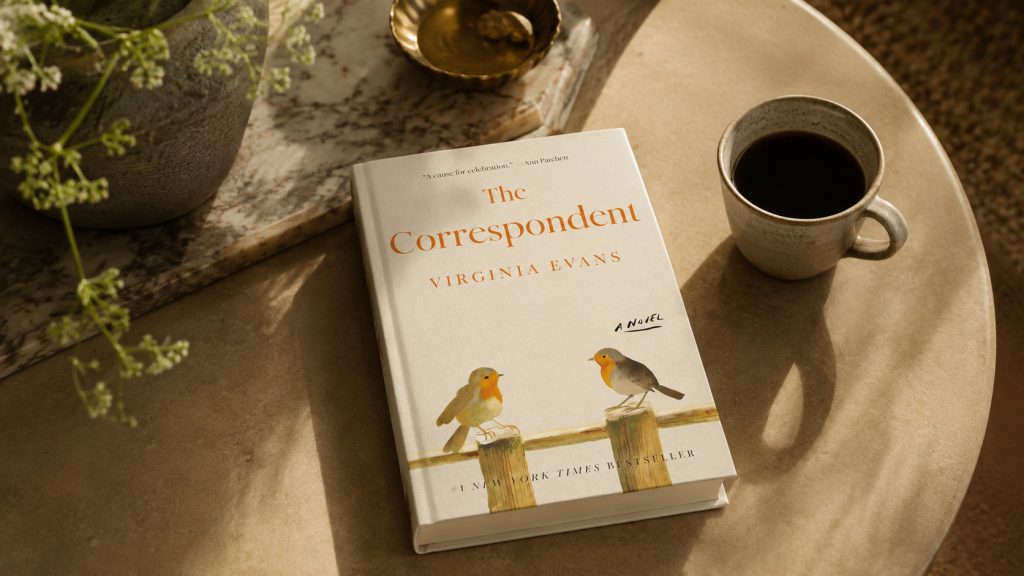
While my 88-year-old husband Sven slept at the long-term facility in Northern Sweden last week, in recovery from a stroke, I read The Correspondent by Virginia Evans. Her epistolary novel is a bestseller that has garnered much support from readers, who share their enthusiasm with friends, creating the word-of-mouth buzz authors can only dream about, but word of mouth was not the reason for my interest in the book. No. My motivation was a good 30 years of writing letters after a move abroad in 1969. I have always considered letter writing a great way to communicate, and this novel proves it.
On the first pages, we meet Sybil Stone Van Antwerp, an outspoken retired lawyer who served as chief clerk to Judge Guy Donnelly. Sybil was adopted as a small child and now lives in Arnold, MD, a suburb of Annapolis. In 2012 and 2013, she writes to her brother Felix in France, to her neighbor Theodore Lübeck, to her best friend Rosalie. Sybil also contacts, on occasion, favorite authors like Joan Didion and Ann Patchett to comment on their latest books. Gradually, readers come to be curious about Sybil’s life and realize they are being given an extraordinary glimpse into the world of a seventy-year-old woman who lives what seems, at first, quite an ordinary life. What makes the difference? Compassion. Sybil cares about people.
Early on, page 50 or so, we learn that she has befriended the son of a former colleague, a boy named Harry Landy. Harry’s letter has contained questions, so Sybil answers them: “I was an English major in college and a pretty good writer. Not knowing another direction to take that would marry writing with something practical and lucrative, I became a paralegal and after a few years of that, went to law school at the University of Virginia.” She then describes working for Judge Donnelly. Harry also asks about her children, and Sybil responds, “I did have three children, as it is in your family, but the second one passed away when he was eight years old. His name was Gilbert.” Now that Evans has added Harry to the group of people Sybil corresponds with, we will follow his life until the end of the novel and learn that she has helped him enormously, serving as a mentor.
At Christmas 2013, one of Sybil’s children gives her the opportunity to submit to KindredProject.org, a company that analyzes DNA, aware that his mother has always wondered about her ancestry. With KindredProject.org, Evans introduces Sybil’s correspondence with Basam Mansour, a Syrian immigrant, who responds to the personal emails she sends him, and eventually becomes a friend.
Woven into her correspondence are short notes to and from Theodore Lübeck. Then comes a long letter from Sybil’s ex-husband Daan in Belgium, and we learn more about Gilbert and realize how devastating this loss was for the family.
As we are reading along, we grow accustomed to the formula of knowing who is writer and who is recipient when, suddenly, several pages appear without any indication. These pages begin with the news that Daan has died. We search for clues on the identity of the person with whom Sybil is sharing this information and come up empty. Evans is not ready to tell. A bit further on, we get another mysterious letter and a name: Colt.
In 2015, KindredProject.org sends word that a DNA match has been found, and we start following yet another thread in this magnificent tapestry of a book. It turns out that Sybil has a close relative living in Scotland. I’m not going to reveal any more of the story except to comment on what a compassionate woman Sybil shows herself to be. I found her interaction with other human beings extremely moving.
In 2018, Sybil shares details about what happened to Gilbert, whom she affectionately nicknamed “Colt.” In a letter written in 2019, she admits to having felt responsible for his death and states that she kept the pain inside her. Over the years, she has grown close to Theodore Lübeck, and it is to her neighbor that she reveals how Gilbert died.
Sybil writes to her daughter Fiona, “Your brother’s death shattered me, and I’ve never been put back to right. It seems Daan was able to continue in love, where I was unable. Grief (the biggest grief in the world) is like–What? What is it that happens to a person? I’ve always felt it is like a scream living inside me. It’s gotten a bit softer over time, but it’s never gone. I walk around the house or dig in the garden or wander the grocery store or sit at my desk and there’s a screaming inside my head like an air horn that warns of war.”
I have never encountered a passage in a novel that so eloquently expresses what it must feel like to lose a child. This is how I felt when I realized my husband Sven had suffered a stroke and would likely soon pass away. I home cared my mom, so I was accustomed to the idea that we would lose her. The extreme elderly die. That’s normal, especially at 97. With Sven, I wanted to scream at the top of my lungs. I imagine this is true for anyone who loses a beloved husband or child, gone before his or her time. Evans’ slow buildup to Sybil’s acceptance of her responsibility for Gilbert’s death make The Correspondent an extraordinary read that I highly recommend.